
Developing AI solutions vs. classic software development - what to keep in mind
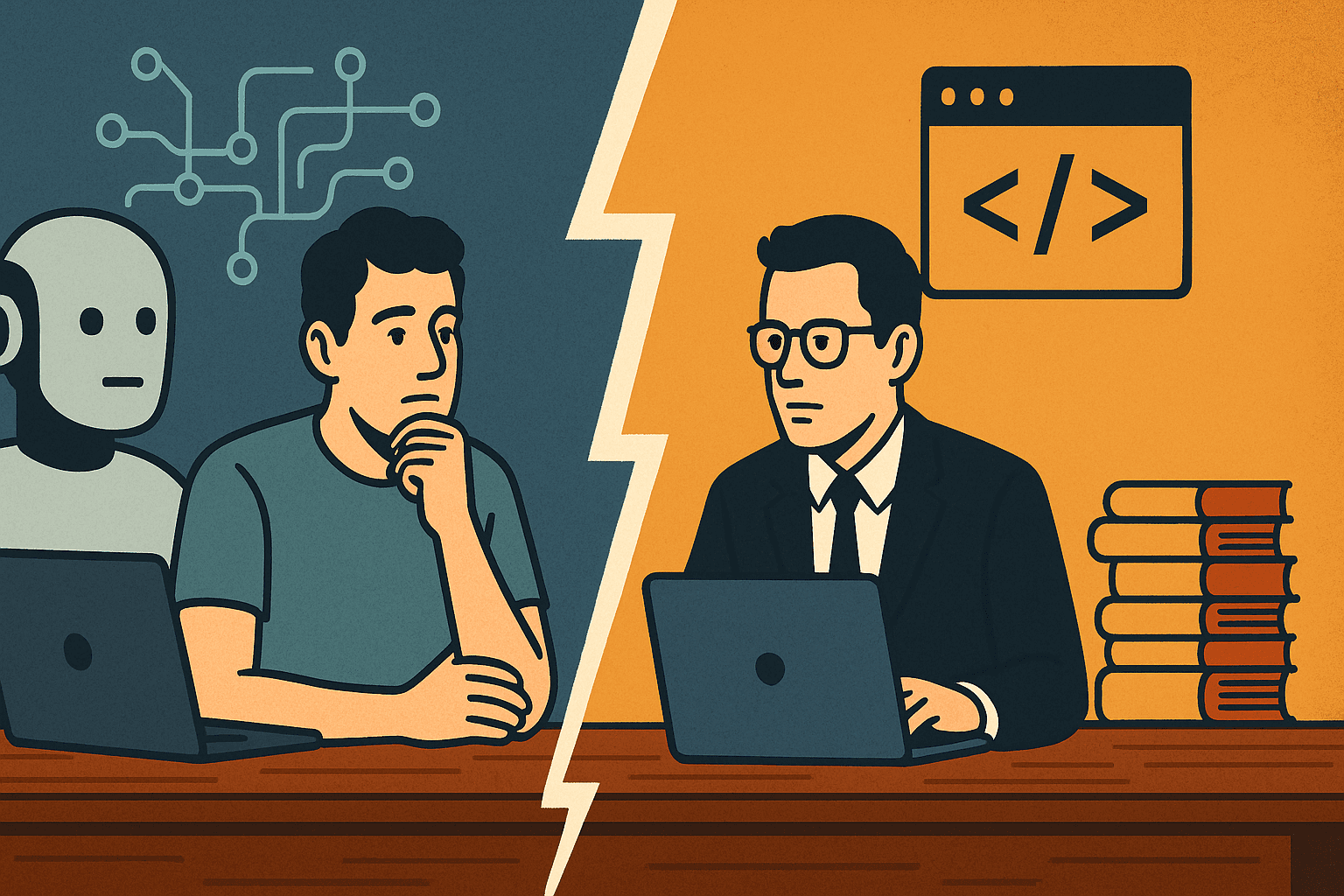
Classic B2B software development has followed proven principles for decades. Requirements are defined, architectures planned, interfaces specified, components developed and tested. Then come structured rollouts, checklists and, ideally, a glass of champagne.
And then along comes AI.
With probabilistic results, constantly new models, a rapidly growing tool ecosystem and an uncomfortable tendency to reinvent itself every few months.
So what should a company do if it wants to build business solutions that use AI to increase revenue, cut costs or take pressure off employees?
The answer: don't descend into chaos, but don't pretend AI is just another module in the backend either.
Because AI development is software development. It just follows different rules in places.
2026 shows particularly clearly that simple LLM integrations have turned into complex AI systems. Modern applications combine different models, data sources, tools and, increasingly, AI agents that can take on tasks within business processes on their own.
Two worlds, one goal: business value
Whether you're building a classic web portal or an AI-powered service agent, in the end one question counts.
Does the solution deliver real business value?
The goal stays the same. Processes should become more efficient, customers more satisfied, employees less burdened and business results better.
With AI, however, the path there differs considerably. Anyone who tries to treat both worlds with the same methods risks unnecessary complexity, high maintenance costs and solutions that are technically impressive but achieve little commercially.
Classic software development: predictability, structure and control
In classic software development, the path is relatively clearly defined. Requirements are analyzed, architectures designed, components developed, tested automatically and rolled out step by step.
The underlying principle is determinism.
Given identical inputs, a cleanly implemented function returns the same result under the same conditions. Its behavior can be specified and verified fairly unambiguously.
The focus is therefore on stability, predictability, reusability and long-term maintainability.
This works extremely well as long as the underlying requirements and technologies don't change constantly.
AI development: probabilities instead of guarantees
Generative AI changes this development model.
A large language model doesn't deliver classic, deterministic function results. Its answers are based on probabilities. Even with identical inputs, results can differ depending on the model version, parameters and context.
This also changes the definition of quality.
An AI application isn't automatically error-free just because it works technically. A prompt can deliver excellent results nine times and produce a completely useless answer on the tenth attempt.
On top of that, modern AI applications have long been more than individual model queries. They combine retrieval-augmented generation (RAG), external data sources, APIs, tool calling and, increasingly, agentic workflows.
AI development therefore requires a different mindset. Instead of only specifying requirements and implementing features, you have to experiment, evaluate and optimize continuously.
You don't just measure whether a feature works, but above all whether it has the desired effect.
Does a new AI service agent really save 40 percent of the support effort? Are requests handled faster? Does customer satisfaction go up?
Those are the questions that matter.
Personally, I like this approach because it puts the commercial success of a solution more firmly at the center. At the same time, it strokes developers' egos a lot less. And I say that as someone who has been developing software for more than 25 years.
Output vs. outcome: the decisive change of perspective
This is one of the most important differences between classic software development and AI development.
In classic software development, success is often measured by whether a defined feature was implemented successfully. A workflow is available, an interface works or a new module has been rolled out.
With AI solutions, that's not enough.
What matters is whether the implemented feature actually improves something.
An AI support agent isn't successful because it generates answers. It's successful when handling time goes down, employees have to deal with fewer routine requests and customers get solutions faster.
One is output, the other is outcome.
Anyone who doesn't understand this difference quickly ends up producing impressive AI demos with no real business value. You build chatbots because chatbots are trendy, or automate documents even though the underlying process is long outdated.
So the right question isn't: what can we build with AI?
But: which problem is worth solving with AI?
The most important architectural mistake: mixing AI logic with business logic
This is where many AI projects fail, even though they initially work very well technically.
The AI interaction is deeply integrated into the existing business logic. Prompts live directly in the application code, model calls are hard-wired into service classes, and context preparation and business rules end up in the same components.
At the latest with the first major model switch or a change in process logic, this becomes a problem.
If your application is married to a specific GPT model, you may have to adapt numerous components when you switch. If prompts are spread across complex if-else cascades, every change becomes a potential source of errors.
The right answer is: separation of concerns.
The business logic should work independently of the AI technology used. It defines business rules, processes and the required results.
The AI layer takes on tasks such as language processing, interpretation, context preparation and generation.
Ideally, AI is treated as a standalone, replaceable component. Models, prompts and context strategies remain configurable without having to rebuild the entire business application.
Because the AI market changes quickly. Your business processes shouldn't have to change with every technological innovation.
AI needs different tools, but the same professionalism
A common mistake is to equate AI development with hackathons, prompt tinkering and rapid prototyping.
Experimenting is important. Especially at the start of a project, you have to find out which models, prompts and architectures are suitable.
But a successful prototype doesn't automatically become a production-ready business solution.
Professional AI applications need traceable versioning of prompts, systematic evaluations and automated regression tests. Changes to models or prompts must be checked before they go into production.
Logging and observability are just as important. It has to be possible to trace which model generated an answer, which context was used, which tools were called and what costs were incurred.
Agentic applications add further requirements. Tool calls need clear permissions, sensitive actions may need to be approved by humans, and errors must be caught in a controlled way.
Security and data protection are also part of the architecture from the start. Prompt injection, uncontrolled data access and overly broad permissions can pose significant risks.
So AI development doesn't need less professionalism than classic software development, but a different form of quality assurance.
2026: agentic AI, MCP and new requirements
A key development of recent years is the shift from simple AI chatbots to agentic systems.
Modern AI agents can increasingly handle multi-step tasks. They access data sources, use APIs, interact with enterprise software and coordinate different processing steps.
An important building block here is the Model Context Protocol (MCP). It enables AI applications to access external tools and data sources in a standardized way.
This lets companies connect AI features more flexibly with CRM systems, ERP solutions and other enterprise applications, without having to build every integration individually for a specific model.
However: the more an AI agent is able to do, the more important permissions, control mechanisms and traceable execution processes become.
An agent that is allowed to read information doesn't automatically need permission to change customer data or trigger payments.
The future of AI development therefore doesn't lie in connecting as many agents as possible. It lies in integrating AI systems into existing business processes in a controlled and commercially sensible way.
In 2026, regulation is part of the architecture too
With the EU AI Act, regulating AI has become a concrete part of software development.
Key parts of the European AI regulation have applied since August 2, 2026. These include transparency obligations for certain AI systems. For example, users of relevant interactive applications must be informed that they are communicating with an AI.
For companies, this means compliance shouldn't only be considered shortly before go-live. Already at the design stage, it must be clarified which regulatory requirements apply, which data is processed and which documentation obligations exist.
The distinction between risk classes is crucial here. Not every AI application is subject to the same requirements. Certain high-risk applications have their own transition periods until 2027 or 2028.
Here too, a clean architecture helps implement regulatory requirements traceably and efficiently.
What companies should consider when developing AI solutions
These developments give rise to a few basic principles.
An AI architecture must be designed for change from the outset. The model that delivers the best performance today won't necessarily still be the best choice in six months. Companies should therefore avoid tying themselves unnecessarily to a single provider.
At the same time, business value must be at the center. Not every feature that can be built with AI is automatically worthwhile. What counts are measurable improvements in cost, quality, speed or customer satisfaction.
Consistently separating business logic and AI logic is especially important. Business rules belong in the application, not in a prompt. AI should be integrated as a replaceable component.
Finally, you need professional development and operations processes. Versioning, automated tests, evaluations, monitoring, security and traceable changes are prerequisites for production AI applications.
Prototyping is a good start. But by the third iteration at the latest, you'll want a maintainable architecture, modular components and a solution that can still be developed sensibly in two years' time.
How izz.ONE solves this problem
At izz.ai, we've recognized exactly this dilemma in numerous AI projects. Companies want to use the possibilities of modern AI without having to constantly rebuild their existing software architecture.
This is exactly where our AI middleware izz.ONE comes in.
izz.ONE creates a central integration and control layer between business applications and AI technologies. Companies can use and swap different models such as GPT, Claude or Mistral without having to redevelop their entire business application.
At the same time, AI logic and business logic remain cleanly separated. Prompts, models and context can be configured and managed centrally instead of being hard-coded in the application.
Versioning, guardrails and context management help keep the behavior of AI applications under control and make changes traceable.
MCP support and the Agent Builder add further possibilities. Companies can connect AI features with external systems and tools and implement more complex workflows without having to build every integration from scratch.
The overarching principle always stays the same:
Your business application should stay stable. The AI technology behind it is free to evolve.
That's exactly what izz.ONE is for.
Conclusion: if you develop AI like classic software, you waste potential and may end up paying twice
Artificial intelligence opens up enormous opportunities for the digitalization of companies. At the same time, it changes the demands on software architecture, development and operations.
Anyone who thinks AI can simply be integrated into an existing application as just another feature underestimates the technological and organizational challenges.
This doesn't make the proven principles of classic software development obsolete. On the contrary: clean architectures, clear responsibilities, modular components and professional development processes become even more important.
What needs to change is how you handle the AI technology itself.
You need an architecture that breathes with the market, without your entire business application breaking into a sweat with every technological innovation.
And that's exactly what izz.ONE is for.
P.S.: If your AI system falls apart after the next model update, the problem probably wasn't the model, but your architecture.
If you work with izz.ONE, you can swap the model, adjust your AI configuration and get back to focusing on what really matters: the business value of your application.
That's how it should be.